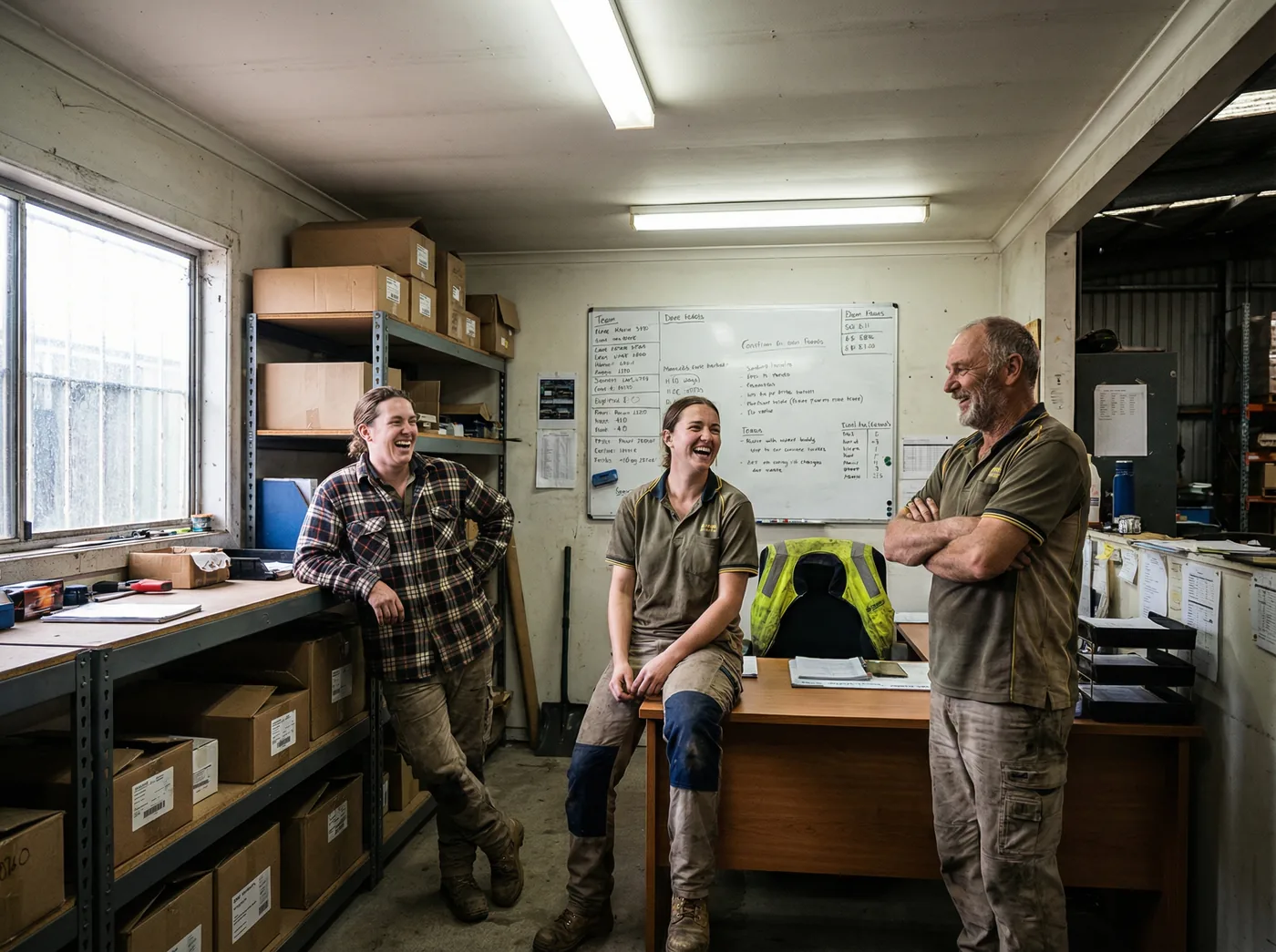



Are your best people
paired up?

AI isn't replacing your team — it's revealing who's ready for what comes next. Give every person on your team a personal AI counterpart that shares a common knowledge base. The more they use it, the smarter it gets — for everyone. The ones who embrace it become unstoppable. That's the future you're building.

your workforce — instantly
10×
team productivity

Your tools don't talk to each other.
And they never will.

$50K+

Average annual SaaS spend for a 20-person company. Slack, HubSpot, Notion, Asana, Salesforce, Zapier — all renting you access to your own data.

0%

Knowledge shared between your tools. Your CRM doesn't know what your project manager knows. Every tool is an island.

Vendor lock-in. Your data lives in their cloud, in their format. Cancel and it disappears. That's not ownership — it's a lease.

This isn't swapping one tool for another.
It's a generational leap.

You're not replacing Salesforce with a cheaper Salesforce. You're replacing fragmented, dumb tools with an AI-native system that understands your business, learns from every interaction, and gets more valuable every single day. The companies that adopt this now build a compounding advantage their competitors can't buy later.

🤝 Personal, not shared

Every person gets their own named AI agent — not a shared chatbot. Your agent knows your role, your context, your work. It's yours.

🧠 Shared knowledge, personal surface

All agents draw from a common knowledge base that grows smarter with every interaction. But each person sees what's relevant to them.

📈 Compounding, not depreciating

SaaS subscriptions reset when you cancel. Your AI infrastructure compounds. Day one it's helpful. Day 365 it's your most valuable asset.

We loved these tools. Then we outgrew them.

Every tool below started as a SaaS product we relied on for years. When AI made it possible to build something better — owned, integrated, and compounding — we did. Here's the measurable lift.

From Website Chatbot to AI-Powered Search

We loved Chatlio for years — live chat right on our website, straight to Slack. Then we built something better for our needs: an AI-powered search tool that answers customer questions instantly from our own knowledge base. Customers can easily escalate to a human when they need to. Less interruptions, less friction, happier customers. No monthly fee.

Before: Chatlio · Now: instant AI answers, fully owned

From Review Collection to Automated Feedback Engine

Customer Lobby was brilliant — real people making real calls, getting our clients talking. Started at $50/mo. Over five years the price crept to $299/mo while response rates fell to practically nothing. They'd pivoted away from the service we loved. So we built our own: automated NPS surveys, review requests, and referral campaigns with 18 A/B tested templates that run themselves.

Before: Customer Lobby ($299/mo) · Now: 536 reviews, fully automated, fully owned

From Duct-Taped CRM to AI Sales Queue

Salesforce, Zapier, and spreadsheets — three tools duct-taped together just to answer "who should I call today?" We built a single system that tells every rep exactly who to contact and what to say, every morning. Contextual, prioritized, with built-in gamification that makes the team actually want to use it. 18,000+ client touchpoints managed.

Before: Salesforce + Zapier + spreadsheets · Now: one system, zero duct tape

From HR Software to Culture in the Workflow

Bonusly was fine, but recognition that lives in a separate app gets forgotten. We wove kudos, achievements, pulse surveys, and team wins directly into Slack — where everyone already works. Recognition happens in the moment, not in a tool nobody opens. 3,791 wins logged across 25 categories and counting.

Before: Bonusly + HR culture software · Now: recognition woven into daily work

From Hiring Chaos to Self-Service Pipeline

Candidates used to bounce between Calendly, Google Forms, and email chains — and someone had to babysit every step. Now they schedule themselves, complete timed design assessments, and book video interviews with zero back-and-forth. Built in a weekend with AI. What used to take two people now takes one.

Before: Calendly + Forms + email chains · Now: 2-person job → 1-person job

From Knowledge Silos to a Shared AI Brain

Notion, Confluence, Google Drive — knowledge scattered across tools nobody searched. The new hire's most common experience: "I know we documented this somewhere." Now every SOP, decision, and document lives in one AI-searchable system. Search by meaning, not keywords. New team members find answers in seconds instead of asking around for days.

Before: Notion + Confluence + Drive · Now: AI-native, compounding knowledge base

Four components. One system. Entirely yours.

Every piece runs on your infrastructure. No vendor cloud. No API dependency. You own the code, the data, and the intelligence it generates.

Cube — Knowledge Engine

Your company's shared brain. Decisions, documents, processes, and institutional knowledge — structured as plain markdown. Each person/agent pair gets a surface tailored to their role. You own your data. Period.

OpenClaw — Agent Engine

The runtime powering your AI agents. Each team member gets a personal agent connected to the Cube. It knows your business, remembers context, and improves every day.

Agent-Ops — Automation

Replace brittle webhook chains with agents that understand intent. They don't just move data between systems — they make decisions and take action.

Private Mesh — Security

Everything runs on a private network. No public APIs. No exposed endpoints. Your data never touches someone else's cloud. You hold every key.

What changes for a 25-person company

Before

  • × Slack threads as institutional memory
  • × HubSpot/Salesforce for CRM ($75/seat/mo)
  • × Zapier duct-taping 15 tools together
  • × Notion for docs nobody updates
  • × New hires take weeks to ramp up
  • × Knowledge trapped in people's heads
  • × $80K–$150K/year in SaaS subscriptions

After

  • Shared knowledge base that gets smarter daily
  • Every person has an AI partner that knows the business
  • Intent-based automation — no more brittle webhooks
  • Living documentation that updates itself
  • New hires productive in days, not weeks
  • Full audit trail on every decision
  • Infrastructure you own — costs stabilize and compound

Three steps to stop renting and start owning

01

Audit

We map your SaaS stack, identify what's needed vs. what's bloat, and design your AI agent architecture. You'll see exactly where the savings and leverage come from.

02

Deploy

We become your AI engineering team. We set up your private infrastructure, deploy the Cube, configure your agents, and migrate your knowledge. Typical deployment: 2–4 weeks.

03

Compound

Your agents learn, your knowledge compounds, and your SaaS bills shrink. We stay on as your AI team — ongoing support, optimization, and new capabilities as you grow.

While you're evaluating,
your competitors are compounding.

This technology compounds. Every day you wait is a day your competition pulls ahead. The companies that move now won't just have better tools — they'll have an institutional intelligence advantage that can't be caught with a credit card and a quick implementation.

Six months from now, you'll wish you started today.

Get Started Before They Do

An investment in infrastructure you own forever.

Not a subscription. Not a license. A compounding AI workforce deployed on your infrastructure. You pay once to build it. You own it from day one.

Starter

2–10 people

$15K

one-time setup

$1,500/mo

support + updates

Growth

10–25 people

$35K

one-time setup

$3,000/mo

support + updates

Enterprise

50+ people

Custom

scoped to your needs

Custom

dedicated support

The Math

TYPICAL SAAS SPEND: $100K/YEAR

Slack + HubSpot + Salesforce + Notion + Zapier + Asana + Google Workspace + 10 other tools

YEAR 1 WITH PAIREDUP

Setup: $50K + Support: $60K + Infra: $6K = $116K

SaaS reduced to ~$40K. Total: $156K — you're investing, not saving. Yet.

YEAR 2+

Support: $60K + Infra: $6K + Remaining SaaS: $25K = $91K/year

Plus: a compounding knowledge base, an AI workforce, and infrastructure you own outright.

3-YEAR VIEW

SaaS route: $100K → $120K → $140K = $360K spent, $0 owned

PairedUp: $156K → $91K → $91K = $338K spent, infrastructure owned forever

Cancel anytime. Your system keeps running. Your knowledge keeps compounding. Updates stop — that's it. No broken contracts. It's yours.

Infrastructure costs are separate — server hosting and AI model tokens typically run $50–500/mo. You control the accounts, you see every bill. Or let us manage it.

"Isn't giving AI agents access to everything... risky?"

Yes. Let's talk about it honestly.

AI agents with tool access carry real risk. We don't pretend otherwise. But here's the question nobody's asking: compared to what? Right now your data lives across 15 SaaS platforms, each with their own breaches, their own employees with access. That's not security — that's hope.

Private mesh network

Agents operate on a private network. Nothing exposed to the public internet. No open ports. No attack surface.

Your infrastructure

No third-party cloud handling your data. You control the servers. You hold the SSH keys. We set it up — you own it.

Role-based access

Each person/agent pair sees only what they should. Sales doesn't see engineering internals. Permissions are built in.

Full audit trail

Every agent action logged in plain text. What it did, when, why. Try getting that from Salesforce.

You hold the kill switch. Always.

Your agents run on your machines. Something wrong? Pull the plug. No support ticket. No waiting for a vendor. You're in control.

The anti-lock-in guarantee

If you decide this isn't for you, here's what you take with you: a folder of markdown files containing every piece of knowledge your company has generated. Open them in any text editor. They work everywhere because they're just text.

Compare that to canceling Salesforce.

What if PairedUp disappears tomorrow?

Your agents keep running. Your knowledge stays in markdown files on your servers. You'd lose ongoing support — that's it. The system is designed to survive without us. That's the whole point.

Who this is for

Good fit ✓

  • Operations-heavy companies (15–60 employees)
  • Currently spending $40K+ per year on SaaS tools
  • At least one person who "gets it" — a technical founder or operator
  • Already using AI informally and ready to go all-in
  • Value ownership over convenience

Not a fit ✗

  • Companies looking for a chatbot widget
  • Quick AI demo to impress investors
  • Organizations where SOC2 certification is the primary buying criterion

Ready to pair up?

Your data, your agents, your infrastructure — from day one, forever.

We work with a small number of companies at a time.